From the year 2025 to the year 2525 will be a period of 500 years. And long-term thinking, especially as enjoined by the 2024 UN Pact for the Future, requires us to plan for Africa’s future in the next 500 years and beyond.
Africa is the oldest continent with human presence on Earth, recognised as the birthplace of humankind, and often described as the Cradle of Humanity. Thus, Africa has the longest known civilisations. Africa once had globally-renowned empires and kingdoms such as those of Azania, Bamum, Benin, Congo, Dahomey, Ethiopia, Egypt, Ghana, Mali, Songhai, Wanga, and Zulu, among others. Mali produced the University of Timbuktu, the first ever university in the world, and the richest man in human history—Mansa Musa. Egypt produced the Pyramids, part of the world’s everlasting wonders.
But activities from outsiders have fundamentally changed the destiny of Africa and Africans in the past 500+ years. These activities include notably the European enslavement of Africans that began more or less officially in July 1555 when a small group of Africans from Shama (modern day Ghana) described as slaves were brought to London by John Lok, a London-based slaver. The dehumanising Transatlantic Slave Trade lasted between the sixteenth and nineteenth centuries and was followed by the European colonisation of Africa between the nineteenth and twentieth centuries, leading to the destruction or slow-down of African civilisations and the partial disregard and erasure of African agency. African enslavement by Arabs is not left out.
African history did not begin with these unfortunate foreign interferences: indeed, African history stretches far beyond the Transatlantic Slave Trade, meandering through powerful empires and kingdoms far into the past. However, the African continent has changed tremendously, for better and for worse, since these tragic encounters with Europe and other foreigners.
That so much has happened in Africa over the past 500 years, so to speak, demonstrates how much we as Africans can intentionally shape our continent in the long-term henceforth. Therefore, we need to avoid the negative dynamics of the past from playing out again on our continent: we have to learn from the past while looking out to the distant future. This is where Vision Africa 2525 (#Africa2525) comes in. Now that long-term thinking and sustainability are obligatory, we should imagine hopeful futures for Africa far into the future, at least 500 years from today. This means planning for our future generations, roughly 20 generations from us given that a generation is 25 years.
Certainly, there is evidence of such long-term thinking around the world, including Africa, not just the seven-generations principle of Indigenous stewardship. For instance, Zealandia, Te Mara a Tane, “an ecosanctuary in New Zealand’s capital city of Wellington, … has a 500-year vision of restoring the forest and freshwater ecosystems of the valley where it resides as closely as possible to their prehuman state.” While various African countries have their long-term development plans, the African Union has Vision 2063 as the blueprint for the long-term transformation of Africa. The AU’s Vision 2063 is relatively very short when compared to the vision for Zealandia and, moreover, Vision 2063 was designed in the classical top-down approach without grassroots consultations.
This explains why Vision Africa 2525 seeks not only to complement and augment Vision 2063 but also to ensure that the new vision is designed collectively in a bottom-up approach, of course without excluding top-down contributions and collaborations. Within the context of #Africa2525 we should build on our past errors and successes, shift negative narratives about Africa, spark new conversations, imagine new possibilities for Africa’s prosperity and global influence, curate new stories and visions, experiment with new forms of inclusive governance, and build or weave social movements for long-term governance and positive transformation.
We should use strategic foresight, collective intelligence, indigenous knowledge, scientific evidence, and imagination to create visions for the Africa that we want in the next 500 years or more starting from our current epoch of polycrisis and polyopportunities. #Africa2525 should be our continental Northern Star, helping us to navigate uncertainty and design better and hopeful futures for all of Africa: villages, kingdoms, indigenous communities, towns and cities, provinces, countries, subregions, continent, and diaspora in an interconnected and interdependent world. These should include village assemblies, municipal assemblies, citizen assemblies, multispecies assemblies, national conversations, regional conversations, webinars and online or virtual townhalls (whether local, national or continental), and much more.
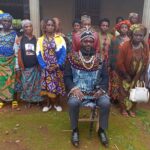
Prior to and since the 2024 historic UN Summit of the Future, we have supported activities and initiatives for future generations and long-term governance in African communities, countries and regions such as the Congo Basin, Mbessa (Mbesa), Cameroon, Kenya, and Nigeria. In this process, we have really learned the importance of intervening and building narrative North Stars across different levels of governance (local, national, and transnational) and raising transformative movements, especially by leveraging the power of indigenous communities as well as bottom-up and top-down efforts. Under the continental umbrella of #Africa2525, we now hope to harness initiatives and interests from many different places and weave them into narratives of collaboration, thereby affording African peoples avenues and platforms for turbocharging their work by brainstorming, collaborating, co-creating, imagining, seeding, and experimenting with new and hopeful visions for their communities, countries, and continent.
In addition, for Vision #Africa2525 to succeed, we must think far into the future while acting positively now. That is why we expect each African at home and in the diaspora to join this campaign and vision. Each participant is encouraged to first do an act of goodness and hope in the present: e.g., plant a tree, volunteer in an orphanage, clear plastic from a river or sea, and so on. This act of goodness and hope should be followed by the sharing of a text (plain text, poem, story), song or video of what Africa should become between now and the year 2525 or beyond. Thus, our visions of Africa in 2525 must be accompanied by proven acts of kindness and hope in the present. The visions and acts of hope should be shared on social media with the hashtag #Africa2525 for tracking. Starting from 2026, we intend to publish open-access anthologies and reports of hopeful visions of Africa 2525 curated thanks to the hashtag #Africa2525.
Furthermore, groups, communities, municipalities, villages, kingdoms, towns, states, provinces, regions, countries, etc. are encouraged to design their specific hopeful visions of the future with #Africa2525 in mind. Positive transformation on any square centimetre of the African continent is transformation for the whole continent! Moreover, visions must not obligatorily stretch to 2525—even visions aiming at 2040, 2050, 2100, 2150, 2200, 2300, 2400, 2525, for example, and anything in between, are logical steps towards #Africa2525. The year 2525 in itself is not our final destination but a significant milestone on our collective journey towards better, hopeful, long-term futures for Africa and our planet Earth. Finally, we encourage both individual visions and collective visioning exercises and workshops in the pursuit of Vision #Africa2525 for a compassionate, prosperous, peaceful, and sustainable Africa and Earth by 2525 and beyond. And each scenario or vision must be accompanied by an act of goodness!
Vision #Africa2525 Origins and Partners:
This project was initiated by Dr Nsah Mala (born Kenneth Nsah) and launched by the following continental consortium of organisations and communities: Mbessa Indigenous Commission for Future Generations and Sustainability, Ajung Indigenous Commission for Future Generations and Sustainability, Nkar Indigenous Commission for Future Generations and Sustainability, Cameroon Network of Initiatives for Future Generations and Sustainability, Partnerships for Future Generations in Africa, Africa Needs Us Foundation (ANUF), Heart of Hope Cameroon (HoHCa), Grassland Peace Centre (GRAPEC), Unity Foundation Cameroon (UFC), Ecological Balance Cameroon, Society for the Promotion of initiatives in Sustainable Development and Welfare (SOPISDEW) Cameroon, … Kindly note that this is a dynamic and organic project and this list of partners, both organisations/institutions and communities/territories, will be updated as the project grows like a tree across time and space.